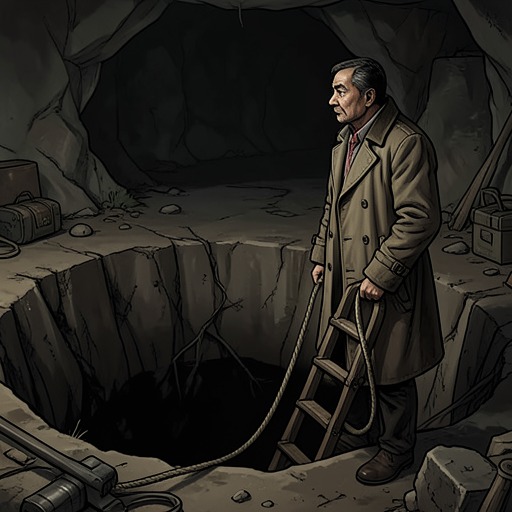
Telephone Woman
The Wind-Up Bird ChronicleThe Telephone Woman is an enigmatic, unnamed figure whose brief appearance helps carry Toru Okada through a wall in a dreamlike encounter connected to his time in the well. She remains difficult to identify: Okada considers whether she might be calling him, but distinguishes her from May Kasahara and Creta Kano, and later recalls her as the guide who led him away from danger. Her importance lies less in a disclosed biography than in the way her appearance unsettles the boundary between imagined experience and bodily consequence.
Identity and Introduction
Okada has no established account of the Telephone Woman’s identity. After reading Kumiko Okada’s letter, he hears the telephone ring in the middle of the night and briefly wonders whether the caller could be her, May Kasahara, Creta Kano, or the mysterious woman. The call proves to be from Malta Kano, clarifying that the Telephone Woman is not the caller and that Okada’s speculation reflects the number of women he associates with unanswered questions around him.
The figure is therefore introduced through uncertainty rather than through a conventional meeting. Okada can imagine her as a possible source of a message, but the passage supplies no confirmed explanation of who she is or how she might communicate with him. Her presence is registered as part of the novel’s unsettled field of telephone calls, absences, dreams, and incomplete knowledge.
The Wall-Passage and Its Consequences
Okada later connects the mark on his cheek to an experience in the well. In a predawn dreamlike passage, he remembers the Telephone Woman taking him by the hand and leading him through a wall so that they could escape someone entering a hotel room. He recalls heat on the exact area of his cheek that later bears the mark, although he cannot explain any physical cause-and-effect connection between the passage and the mark.
The mark becomes a material reminder of an event whose status remains uncertain. Okada considers whether it was impressed on him by a dream or illusion, but also treats its persistence as evidence that the experience happened in some consequential sense. The Telephone Woman’s guiding action thus links an obscure passage between spaces to a change on Okada’s body, without resolving whether the passage belongs to dreaming, perception, or another layer of experience.
Relation to Okada’s Experience of the Well
The figure’s appearance is connected to the novel’s treatment of bodily presence and unstable reality. In the well’s total darkness, Okada struggles to remain certain that he exists: he checks his voice by clearing his throat and his face by touch, while feeling that his body is losing its density and weight. The Telephone Woman’s remembered hand-guidance belongs to this larger pattern, in which the body is both the means of verifying reality and a site where reality becomes uncertain.
Okada also remembers an intimate dream involving Creta Kano and recognizes that he cannot separate its real elements from the unreal. Against that uncertainty, the Telephone Woman’s role is strikingly practical: she leads him away from an approaching danger. Yet the bodily mark that follows prevents the episode from remaining a self-contained dream in his mind. The figure’s narrative function is to make that contradiction harder to dismiss, not to explain it.